
A watch crystal has to be chosen to within a tenth of a millimetre. A few tenths too small and the crystal sits loose in its seat; a few tenths too large and it will not go in at all. The crystal gasket must match the bezel just as closely. A crystal's diameter, its thickness or a gasket's cross-section cannot be measured with a basic ruler.
For accurate readings, you need a precision instrument. Calipers are the watchmaker's tool for these small dimensions.
How to use calipers
Calipers are widely used in watchmaking, but also in mechanical engineering and plumbing (inside and outside tube measurements, for example). They are far more precise than a ruler: accuracy ranges from 1/10 mm to 1/50 mm. They measure length, width, hollow surfaces and depth. To get a correct reading you need to know how to use them.
The parts of a pair of calipers
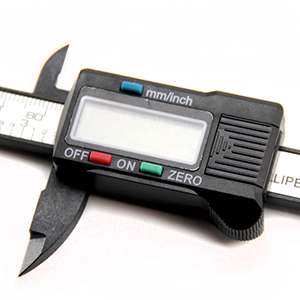
A pair of calipers consists of two graduated parts. The main rail is fixed. The second part is movable along the main rail and can be locked with a thumbwheel. We're showing digital calipers here, but mechanical versions exist too.
The jaws
The jaws sit on a graduated scale in millimetres or half-millimetres. One jaw is fixed, the other slides. Depending on the jaw you use, you can measure inside or outside dimensions.
The slide
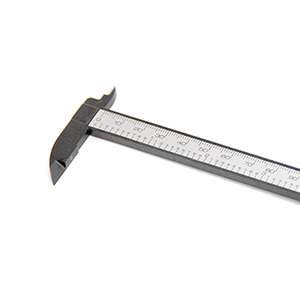
The slide carries a graduated vernier scale and a depth probe extending out the back.
Using calipers - inside, outside and depth
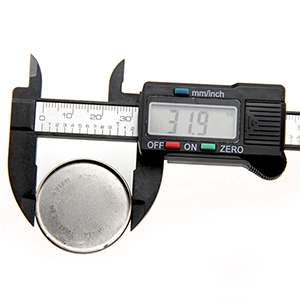
When closed, the jaws form a single point and both readings are at 0 mm. As you open the jaws, the vernier no longer aligns with 0. Place the object you want to measure between the fixed and movable jaws and gently close the jaws until they make contact.
Depending on the caliper model, you can measure outside dimensions, inside dimensions and depth.
Example caliper measurements
Diameter of a watch crystal
Lay the crystal flat between the outside jaws and close them without forcing. Take two or three readings, turning the crystal each time: the largest value is its diameter. For a crystal with a rim or a base, measure the widest part, the one that fits into the seat. You can then search for that diameter with the Find my crystal tool.
Thickness of a watch crystal
Grip the crystal between the outside jaws, at the edge for a flat crystal. For a domed crystal, note the edge thickness and then the total height at the top of the dome: both values help you find an equivalent model. The different shapes are described in our Types of watch crystal guide.
Crystal seat in the bezel
If the old crystal is broken or missing, measure the seat with the inside jaws, edge to edge through the centre. For an acrylic crystal, allow 0.1 to 0.2 mm more than the seat as a rule: it is slightly compressed when fitted. For a mineral or sapphire crystal, choose the exact diameter of the seat.
Crystal gasket
Take the inside diameter with the inside jaws, the outside diameter with the outside jaws, then the cross-section (the gasket's thickness) by gripping it lightly without squashing it. The Measure a gasket guide covers the method, and the Replace a gasket guide explains fitting.